Understanding 3D Isometric Landscape: A Visual Tool for Modern Design
3D isometric landscape has become a go-to visual style for designers working across multiple industries, from urban planning to digital illustration. At its core, this technique uses a pseudo-3D perspective to create depth without the complexity of full 3D modeling. The result is a clean, scalable, and visually engaging representation of environments like small towns, cityscapes, or parks. Whether used in banners, infographics, or architectural presentations, the 3D isometric approach offers a balance between realism and abstraction that resonates with modern audiences.
What Makes 3D Isometric Landscape Unique?
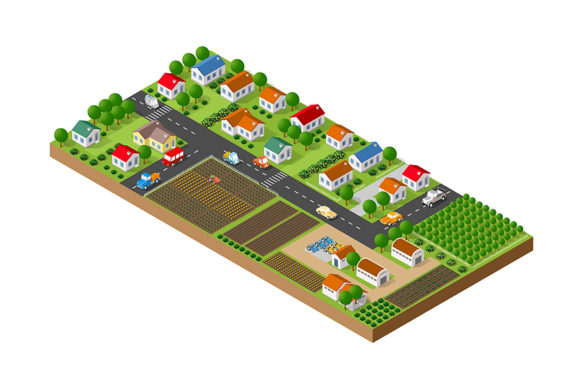
Unlike traditional 2D illustrations, 3D isometric landscapes simulate depth by using a fixed angle—typically 30 degrees—to render objects. This eliminates the need for perspective distortion, making it easier to align elements like buildings, trees, and roads in a cohesive layout. It’s particularly effective when designing environments such as a 3D isometric landscape of a small town with houses and streets with trees, where clarity and spatial relationships are important.
One of the key benefits of this style is its scalability. Because it doesn’t rely on vanishing points, you can extend the scene infinitely without compromising visual consistency. This makes it ideal for map design, urban planning visuals, and interactive web banners where users may pan or zoom through a scene.
Comparing 3D Isometric Landscape with Other Visual Styles
When evaluating visual design tools, it’s important to understand how 3D isometric landscapes compare to alternatives like orthographic projections, full 3D rendering, and 2D flat design. Each has its own strengths and tradeoffs:
- Orthographic Views: These offer a top-down or side profile without depth. While simpler than isometric, they lack the visual richness that makes scenes engaging.
- Full 3D Rendering: Offers realism and dynamic camera angles but requires more processing power and time. It’s often overkill for conceptual or illustrative use cases.
- 2D Flat Design: Clean and minimal, but struggles to convey spatial relationships effectively. It works well for icons or simple graphics, but not for complex environments.
3D isometric landscapes strike a middle ground—providing enough depth to communicate spatial layout without the overhead of full 3D modeling. This makes them ideal for applications like cityscape illustrations, environment mockups, or travel guides where visual clarity is key.
Strengths and Limitations of 3D Isometric Landscape
One of the major strengths of this approach is its adaptability. You can use it to illustrate a wide range of settings, from a retro-style village to a modern urban park. The style lends itself well to flat and colorful designs, making it popular in digital marketing, UI/UX design, and infographic creation.
However, there are tradeoffs to consider. Since isometric projection doesn’t use perspective foreshortening, distant objects don’t appear smaller. This can make large-scale environments feel less realistic compared to full 3D environments. Additionally, creating detailed elements like apartment buildings, restaurants, or markets in isometric view requires careful planning to avoid visual clutter.
Best Use Cases for 3D Isometric Landscape
This style shines in scenarios where clarity, scalability, and aesthetic appeal are important. Here are a few practical applications:
- Interactive Maps: Especially useful for urban navigation or event planning, where users need to understand spatial relationships quickly.
- Architectural Presentations: Helps convey layout and design intent without the complexity of full 3D walkthroughs.
- Educational Infographics: Ideal for explaining urban development, transportation systems, or environmental planning in a visually engaging way.
- Digital Marketing: Used in banners, social media posts, and landing pages to showcase products or services within a contextual environment.
For example, a 3D isometric landscape of a small town with houses and streets with trees can be used to promote a local business directory, a real estate platform, or a travel guide. The visual clarity helps users quickly grasp the layout and context of the scene, enhancing engagement and comprehension.
When to Consider Alternatives
While 3D isometric landscapes are versatile, they may not always be the best choice. If your project requires photorealism or dynamic camera movement, full 3D rendering may be more appropriate. Similarly, if you're designing for very small screens or minimal bandwidth, a simpler 2D flat design might offer better performance and clarity.
Also, for highly technical applications like construction blueprints or engineering schematics, orthographic or axonometric projections may be more precise. In such cases, the visual richness of 3D isometric may actually interfere with technical accuracy.
Choosing the Right Tools and Techniques
Creating a high-quality 3D isometric landscape typically involves vector-based tools like Adobe Illustrator, Sketch, or Figma. These platforms allow for precise control over shapes and alignment, which is essential for maintaining the isometric grid. Some designers also use 3D modeling software like Blender or SketchUp to generate base layouts before converting them into isometric projections.
When designing a 3D isometric landscape of a small town with houses and streets with trees, it’s important to maintain consistent scale and alignment. Using a modular approach—where elements like houses, shops, and park areas are built as reusable components—can streamline the process and improve consistency.
Color and texture also play a key role. While the style is often associated with flat and retro aesthetics, adding subtle gradients or textures can enhance depth and realism without breaking the isometric illusion.
Final Thoughts: Is 3D Isometric Landscape Right for Your Project?
3D isometric landscapes offer a compelling mix of visual clarity, flexibility, and efficiency. They are particularly well-suited for projects that require a balance between realism and abstraction—such as urban design, digital illustration, and infographic creation. However, like any design approach, they come with limitations that should be weighed against your specific needs.
If you're looking to visualize a small town, cityscape, or residential environment in a way that’s both engaging and easy to understand, 3D isometric landscapes are a strong contender. But if your project demands high realism, dynamic movement, or technical precision, you may want to explore alternative approaches.
In the end, the decision comes down to your goals, audience, and resources. By understanding the strengths and tradeoffs of 3D isometric landscapes, you can make a more informed choice and create visuals that truly serve your purpose.