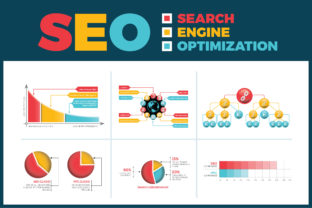
Strategic Value of the Search Engine Optimization SEO Infographic
Visual communication plays a critical role in how information is absorbed, especially in complex fields like digital marketing. The Search Engine Optimization SEO Infographic serves as a powerful tool for distilling intricate SEO concepts into digestible, visually compelling formats. Whether you're a marketer presenting to stakeholders, a freelancer pitching services, or a business owner explaining your strategy to a team, this infographic toolkit offers a structured way to convey value, process, and results without overwhelming your audience.
At its core, the Search Engine Optimization SEO Infographic is a collection of pre-designed, fully editable vector elements that allow users to create custom visuals for reports, presentations, and marketing materials. It’s not just about aesthetics—it's about clarity, consistency, and strategic alignment. When used thoughtfully, these infographic elements can elevate how your audience perceives your expertise and planning.
Why Use the Search Engine Optimization SEO Infographic?
SEO is often misunderstood or underappreciated because its results unfold over time and its processes are not always visible. A well-crafted infographic can demystify key components such as on-page optimization, backlink building, keyword research, and technical audits. The Search Engine Optimization SEO Infographic gives you the tools to present these concepts in a way that aligns with how people process information—visually and contextually.
Consider a scenario where you're onboarding a new client. Instead of sending a lengthy document filled with jargon, you can present a visual roadmap of your SEO strategy using the infographic templates. This approach not only improves comprehension but also builds trust by showing a structured, data-driven plan.
How It Supports Strategic Planning and Communication
One of the most underrated benefits of the Search Engine Optimization SEO Infographic is its ability to support strategic thinking. When you map out your SEO plan visually, you’re forced to clarify your assumptions, sequence your actions, and align your goals. This can be especially valuable when coordinating between teams, presenting to executives, or reporting to clients.
- Positioning: Use the infographic to show how SEO fits into the broader digital marketing ecosystem.
- Productivity: Streamline internal reporting and client updates with consistent, reusable templates.
- Learning: Simplify training sessions or onboarding materials with visual explanations of SEO principles.
- Branding: Maintain a professional and cohesive look across all your marketing and reporting materials.
These elements help you communicate not just what you’re doing, but why it matters in the context of business growth and long-term digital visibility.
When and How to Use It Effectively
The Search Engine Optimization SEO Infographic is most valuable when used as part of a deliberate communication strategy—not as a random visual add-on. Consider using it when:
- You need to explain complex SEO strategies to non-technical stakeholders.
- You're creating quarterly performance reports that show progress over time.
- You're designing marketing materials for lead generation or client education.
- You want to standardize how SEO is presented across your team or organization.
Approach the use of these infographic elements with intention. Start by identifying your audience and their level of understanding. Then, map out the key points you want to highlight. The infographic should serve as a visual guide—not a replacement for deeper discussion—but it can act as a strong foundation for further conversation.
Design Considerations and Practical Tips
Because the Search Engine Optimization SEO Infographic is built with vector files (EPS CS5 format), it offers flexibility in scaling and customization. You can adjust colors, fonts, and layout to match your brand or presentation style. However, this flexibility comes with a responsibility to maintain clarity and consistency.
- Use consistent color coding: Assign specific colors to different types of content (e.g., blue for strategy, green for results).
- Keep text minimal: Infographics are not meant to replace written reports but to summarize and highlight.
- Label clearly: Avoid vague icons or visuals that might confuse your audience.
- Test for readability: Ensure your visuals are legible across different formats and screen sizes.
Also, remember that while the toolkit is easy to edit, it still requires a basic understanding of Adobe Illustrator or similar vector editing software. If you're not familiar with these tools, consider collaborating with a designer or investing in a short tutorial to maximize the value of the templates.
Aligning Infographic Use with Business Goals
For the Search Engine Optimization SEO Infographic to be truly strategic, it must align with your business goals. Ask yourself:
- Are you trying to improve client education or internal alignment?
- Do you need to show ROI or demonstrate progress?
- Is your goal to simplify complex data or to highlight key performance indicators?
Each of these goals will shape how you use the infographic. For example, if your objective is to demonstrate SEO ROI to leadership, your infographic should focus on metrics like organic traffic growth, keyword ranking improvements, and conversion rate increases. If you're onboarding a new team member, your infographic might outline the SEO workflow, key tools, and responsibilities.
Potential Risks and How to Avoid Them
While the Search Engine Optimization SEO Infographic is a valuable resource, it can become counterproductive if used without clear intent. One common mistake is treating the infographic as a shortcut rather than a strategic tool. This can lead to:
- Miscommunication: Overly simplified visuals may omit critical context or nuance.
- Brand inconsistency: Using mismatched colors, fonts, or styles across different visuals.
- Reduced credibility: Presenting data without explanation or source references.
To avoid these pitfalls, always pair your infographic with supporting documentation or a narrative explanation. Use the visual as a starting point, not the final word. And when presenting to stakeholders, be prepared to answer questions that go beyond what's shown in the graphic.
Maximizing Long-Term Value
Infographics shouldn’t be one-off creations. The Search Engine Optimization SEO Infographic is designed for reuse and adaptation. By maintaining a library of standardized visuals, you can streamline future reporting, improve consistency, and reduce design time across projects.
Consider creating a template folder that includes variations for monthly reports, campaign summaries, competitor analysis, and strategy roadmaps. This not only saves time but also ensures that your visual communication evolves alongside your SEO efforts.
Final Thoughts: Using the SEO Infographic Intentionally
The Search Engine Optimization SEO Infographic is more than a design asset—it's a strategic communication tool. When used with purpose, it can enhance clarity, improve stakeholder engagement, and reinforce your expertise. But like any tool, its value depends on how you apply it.
Ask yourself: Are you using visuals to explain, persuade, or inspire? Are you aligning your design choices with your audience’s needs and your business goals? By answering these questions and approaching the infographic as a strategic asset rather than a decorative element, you’ll be able to make better decisions, communicate more effectively, and achieve better long-term results.